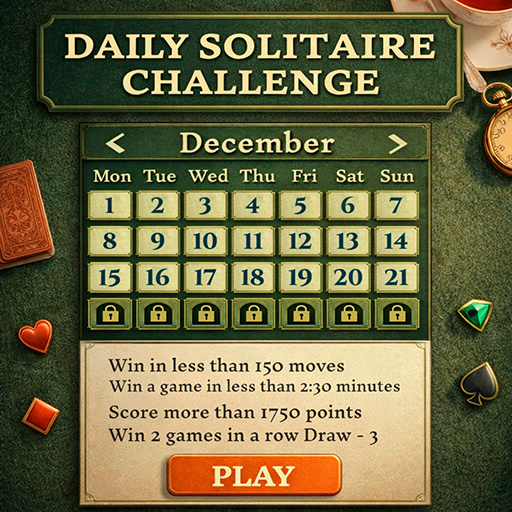
Daily challenges have become a standard feature in modern solitaire games. They encourage habit, create routine, and give players a reason to return every day. But they also come with a common risk: repetition fatigue.
Many daily solitaire implementations rely on a fixed checklist of tasks—win a game, don’t use hints, finish under X minutes. While effective at first, this approach quickly feels mechanical. Players stop engaging thoughtfully and start “clearing the task” instead.
⸻
The Core Problem: Repetition Disguised as Variety
If the structure of the challenge is always the same, changing only a parameter (draw 1 vs draw 3, hints on/off) doesn’t create a meaningful sense of novelty. Players perceive it as the same game wearing a different label.
The key is not adding more rules, but recombining existing mechanics in ways that change player priorities.
⸻
Variation Through Metrics, Not Mechanics
One effective approach is to design daily challenges around internal metrics the player already understands:
- Score thresholds – Achieve a certain point total
- Time pressure – Complete within a time limit
- Combo management – Focus on consecutive successful moves
- Specific in-game actions – Foundation builds, card flips, tableau moves
By combining two or three of these dimensions, you can generate a large space of challenges without introducing new systems. The game remains familiar, but the optimal way to play shifts every day.
One day rewards speed, another precision. One encourages aggressive combo play, another careful setup. The board is the same; the mindset is not.
⸻
Soft Constraints Beat Hard Restrictions
Hard rules (“no undo”, “no hints”) tend to feel punitive. Soft constraints (“reach X points”, “finish under Y time”) feel like goals instead of prohibitions. They invite experimentation rather than compliance.
This subtle difference has a big impact on perceived fairness and enjoyment—especially for long-term players.
⸻
Designing for the Casual HTML5 Audience
At Catafractum, we design our solitaire games with the HTML5 casual market in mind. These players:
- Have lower frustration tolerance than hardcore gamers
- Prefer goals over restrictions
- Value fairness and consistency
- Appreciate variety without complexity
Our approach to daily challenges reflects this understanding. We combine our Klondike solver technology with carefully balanced challenge parameters to ensure every daily challenge feels fresh yet fair.
⸻
Implementation Strategy
Here’s how we structure daily challenges in our HTML5 solitaire games:
- Precompute Challenge Seeds – Use our solver to select appropriate decks offline
- Mix Constraint Types – Rotate between time, score, and action-based goals
- Balance Difficulty – Ensure challenges are achievable but not trivial
- Avoid Punitive Rules – Focus on positive goals rather than restrictions
- Create Progression – Gradually increase complexity throughout the week
This approach keeps development costs low while maximizing player engagement and retention.
⸻
Conclusion
Daily challenges are not about content volume. They are about design leverage.
When done right, they transform a classic, monotone structure into a living system—one that feels fresh every day without losing its identity.
For publishers looking to license solitaire games with sophisticated retention mechanics, this kind of thoughtful design can make the difference between players who check in once and players who return daily.
⸻
Experience Our Advanced Solitaire Features
Ready to see these principles in action? Our solitaire games combine solver-powered fairness with engaging daily challenge systems:
- Premium Solitaire: Crescent Solitaire, Addiction Solitaire
- Streamlined Variants: Addiction Mini
Interested in licensing HTML5 solitaire games with advanced retention features? Check our licensing options and pricing or contact us to discuss your needs.